Real talk: Are we on track to #endmalaria?
This year’s World Malaria Day theme, “Zero Malaria Starts With Me” re-energizes the fight to eliminate malaria which, despite being preventable and treatable, still kills over half a million people every year. While incredible progress has been made in the past 15 years (with over 7 million malaria deaths averted and about 40% reduction in malaria globally), the fight against the disease is now inching towards a tipping point – progress has slowed down in some parts of the world and reversed in a few.
Is drug resistance a threat?
A major challenge confronting malaria elimination is the emergence of drug-resistant malaria in the Greater Mekong Subregion (GMS), including countries like Thailand, Cambodia, Myanmar, Laos and Vietnam. Thailand’s Minister of Public Health, Professor Piyasakol Sakolsatayadorn said to CNS (Citizen News Service): “Drug-resistant malaria is a threat to Thailand and the Greater Mekong Subregion (GMS). This area is the epicentre of drug-resistant malaria. Drug-resistant malaria can become a global health threat if we cannot manage and eliminate drug-resistant malaria in Thailand and the GMS.”
Historically, the GMS region has long been an epicentre of antimalarial drug resistance. In fact, 40-45 years ago, chloroquine resistance had spread throughout the world from this region. So, there are fears about risk of re-emergence of malaria because of anti-artemisinin resistance.
“If drug resistance from Greater Mekong Subregion (GMS) spreads beyond this region, it will have a devastating impact on countries with high burden of malaria” cautioned Alistair Shaw, Senior Program Officer, Raks Thai Foundation.
But science at best is inconclusive, if the spread of drug resistance is a risk. “It is mostly the asymptomatic patients that carry gametocytes in Plasmodium falciparum cases, that specialize in the transition between the human and the mosquito host. In Thailand, less than 5% patients have gametocytes that can transmit to next mosquito cycle. There is no strong evidence so far whether a person who has drug-resistant malaria can transmit this phenotype to the mosquito to continue the transmission of drug resistant parasite to another person,” says Dr Jetsumon Sattabongkot Prachumsri, who is the Director of Mahidol Vivax Research Unit (MVRU), Faculty of Tropical Medicine, Mahidol University in Thailand.
Agrees Dr Tim France, a noted global health expert, who also leads Inis Communication: “At present you can say largely that there is more that we do not understand about malarial drug resistance and we do know we are at a very active learning period. But at the end of the day whether drug resistance is spreading or occurring de novo, the conclusions and essential actions remain the same.”
Governments promised to end malaria
Thai health minister Professor Piyasakol Sakolsatayadorn reaffirmed the country’s target date for ending local transmission nationally: “Thailand is committed to the regional effort, and to eliminate malaria by 2024.”
It is noteworthy to mention that in 2014, 23 Asia Pacific heads of governments had committed to eliminate malaria in this region by 2030, which is in line with the UN Sustainable Development Goals (SDGs).
Thailand’s National Malaria Elimination Strategy was endorsed in 2016 with the elimination goal of 2024. Since then, malaria cases have continued to decline: from 2012 to 2017, the number of malaria cases in Thailand fell by 67%, with a 39% drop between 2016 and 2017. In 2017-2018, malaria cases in Thailand further dropped by 51% (from 14,684 to 7,153).
Challenges confronting the fight to eliminate malaria
Prof Sakolsatayadorn underlined, combating drug resistant malaria with limited pipeline of new drugs as one of the challenges.
Chief Scientific Officer of the World Health Organization (WHO) Dr Soumya Swaminathan agreed: “While there are tools available to deal with malaria, but modelling studies show that to achieve elimination we will need new and better tools by way of better diagnostics, better treatment strategies and also an effective vaccine.”
“Thailand is not only moving towards malaria elimination by 2024 but also making progress towards sub-regional elimination targets within Thailand” said Shreehari Acharya, Project Manager, Regional Malaria CSO Platform. Last year on World Malaria Day 2018, Thailand declared 35 provinces (out of a total of 76) malaria-free. But malaria is concentrating towards Thai borders making the fight to end the disease even more complex. “As we slowly move towards elimination of malaria in Thailand, the cases continue to shift closer to borders and more hard-to-reach mobile migrant populations” says Alistair Shaw of Raks Thai Foundation.
To fortify Thailand response to eliminate malaria from within its border and from the Greater Mekong Subregion, the Global Fund to fight AIDS, Tuberculosis and Malaria (The Global Fund) pumped in the largest multi-country regional grant of US$243 million (2018-2020) to accelerate elimination of drug-resistant malaria.
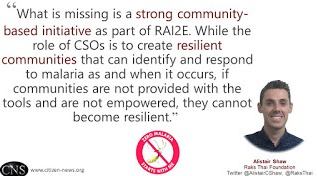
“Our role has been to create malaria resilient communities who can identify themselves when they suspect malaria cases and can respond to it through all the different mechanisms that have been set up and the links that have been made to health services. We have also made strong relationships with the local government officers to conduct mobile testing and prevention education in vulnerable populations which include mobile migrant populations from Cambodia, Vietnam, Laos and Myanmar, as well as mobile Thai ethnic minority communities traveling through forests or across borders for various activities. Our work is to extend the reach of the government services to communities that are located very far from local government health services and do not feel comfortable, or are unable, to access a conventional health service,” says Alistair Shaw of Raks Thai Foundation which is one of the recipients of this Global Fund grant.