Malaria Infection Study in Thailand

(Malaria Infection Study in Thailand)

The Malaria Infection Study in Thailand (MIST) is a program of research to accelerate development of vaccine and drugs for Plasmodium vivax. MIST is a collaboration between the Mahidol Vivax Research Unit (MVRU) and Mahidol Oxford Tropical Medicine Research Unit (MORU), funded by Wellcome, UK. The studies will involve carefully giving a controlled number of parasites to healthy volunteers and will be conducted at the Faculty of Tropical Medicine, which has a Clinical Research Centre, in dedicated, modern, well equipped facilities. The team has more than 50 years’ experience conducting world-class malaria research. The research will provide the platform for testing potential vaccines and drugs as well as other interventions for P. vivax. https://mist.in.th

H_Residual-Malaria-003

Epidemiology and Transmission of Residual Malaria in Thailand

Epidemiology and Transmission of Residual Malaria in Thailand

The world is trying to eradicate Malaria. Countries in Asia pacific aims to eliminate malaria from the region by 2030. A key challenge to achieve this aim is the remaining large number of asymptomatic carriers, local endemic residents who are infected by malaria parasites but do not suffer acute malaria symptoms. Unaware of their silent infection, most people do not seek anti-malarial treatment and become the source of parasites that can be transmitted to others including naïve travellers. Understanding the behavioral and demographic factors that underlie asymptomatic malaria infection will help policy makers identify individuals under high risks for proper intervention.

Over the past several years, we have been conducting malaria mass blood and vector surveys in several hot-spot areas along the Thai-Myanmar border. Our field sites run from villages of northern Tak province to rubber plantations in southern Ranong province. Both cross-sectional and cohort study designs are used to precisely track malaria infections in human and their evolution over time. Mosquito captures are used to understand the seasonal dynamics of mosquito population as well as to identify the major malaria vectors in the study areas. These studies are also conducted in association with questionnaires developed to extract help identify groups of people who are under highest risk of malaria infection and to determine the effectiveness of interventions currently used in the country such as bednets and indoor residual sprays.

We have found that the vast majority of all malaria infection in the endemic area is asymptomatic and that P. vivax has undoubtedly become the most common parasite in Thailand. Anopheles minimus and Anopheles maculatus are the main malaria vectors. The wealth of data that we have accumulated over the past decade have helped us determine the hot spots of malaria infections and identified people who are most likely the silent parasite carriers. Whereas ethnic differences exist across our study populations, the major risks factors identified are constant. Importantly, we found strong association between indoor residual spraying with a reduction of malaria infection. We thus fully support the continuation of this intervention in the national malaria program.

Publications:

Key Information

In collaboration with:
Liwang Cui, Professor, University of South Florida
Guiyun Yan, Professor, University of California Irvene
Ivo Mueller, Professor, Walter + Eliza Hall
Ingrid Felger, Professor, Swiss THP
Funded by:

Gallery

H_vivex-malaria001

Transmission Blocking Vaccines for Vivax Malaria

Transmission Blocking Vaccines for Vivax Malaria

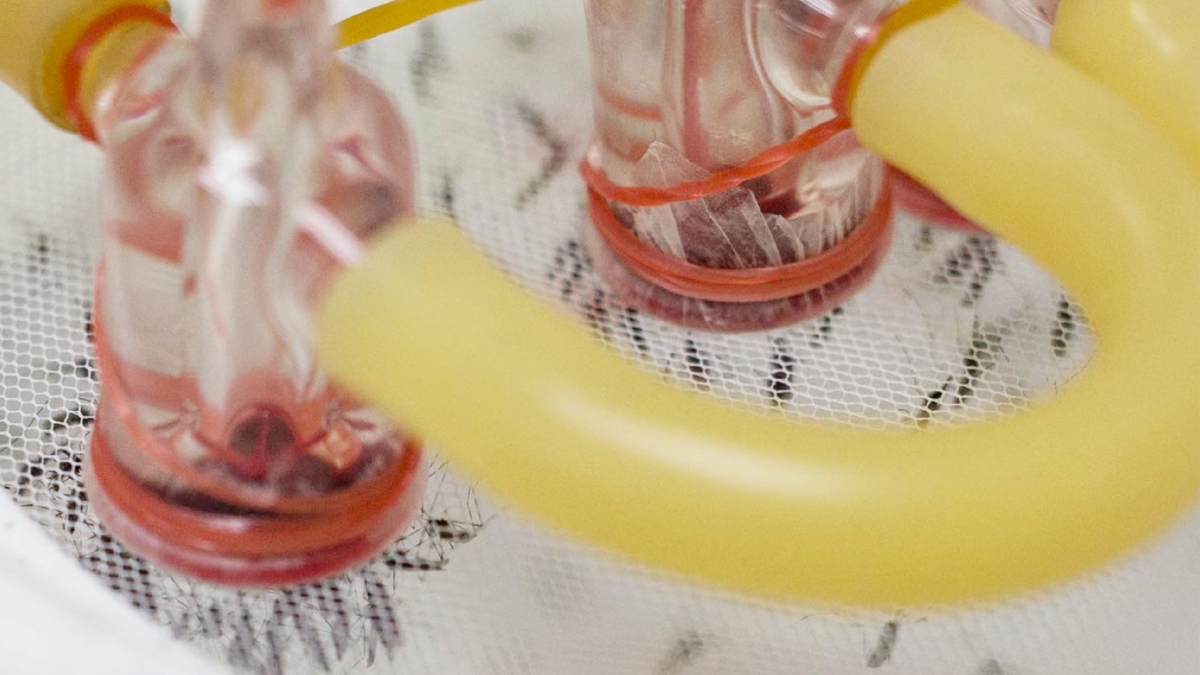
The MVRU team and its partners have been a pioneer in discovering and testing new candidates for malaria transmission blocking vaccines (TBVs). These vaccines aim to interrupt transmission of malaria parasites from an infected individual to mosquitoes. Utilizing laboratory reared An. dirus, a Southeast Asian vector of malaria, and malaria infected blood from volunteers, we have been evaluating TBV candidates since 1998 and participated in a clinical Phase I study for the most advanced candidate Pvs25. Together with Mahidol Oxford Research Unit (MORU), we are in the process of initiating the first Controlled Human Malaria Infection study for Plasmodium vivax in a malaria endemic country.

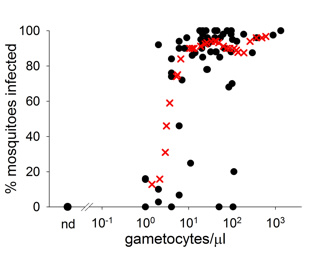
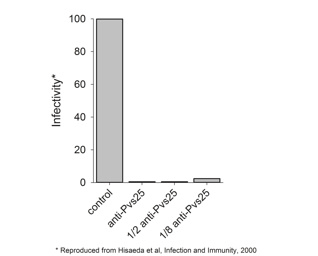
Our works have contributed to down selection of key candidates for P. vivax malaria TBV. Using mosquito membrane feeding assays (MFA), we have shown that several candidates (Pvs25, Pvs28, Pvs45/58, Pvs230, AnAPN1) can significantly reduce malaria infection of mosquito. In some cases, man-to-mosquito transmission of the parasite can be blocked completely. Our works have provided key vaccine efficacy data essential for advancing vaccine candidates to clinical trials.

Publications:

Key Information


Gallery